EXPERIENCE
01
Borrow Aggregate Sources, Northern BC
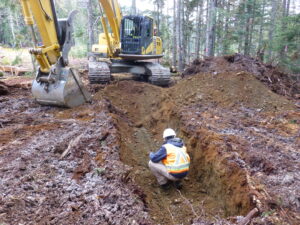 Evaluation of potential borrow aggregate sources that were required for the construction of a pipeline in British Columbia was undertaken. Work included high-level mapping, vetting of previous aggregate targets and development of new and alternative rock and gravel sites; mapping and exploration (test pits, drilling) and testing of samples; Acid-Rock Drainage assessments; permitting under the BC Mines Act; preparation of a mine design, proposed closure/reclamation designs.
02
Ballymun Centre, Dublin
A landmark case in the High Court in Ireland in which the Plaintiff successfully brought a claim of unfit-for-purpose crushed rock fill that had been supplied by a quarry. The Plaintiff proved his case that the rock was poor-quality stone that contained highly reactive framboidal pyrite that resulted in heave of the floor slabs, which in turn damaged the building.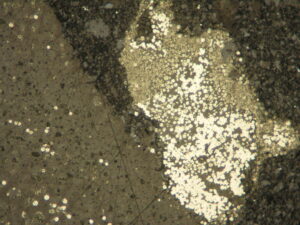
Clendenin Elementary, West Virginia
Retained by Kanawha County School Board to undertake an investigation of potential for pyritic heave of the on-site sandstone rock that was excavated and initially used as structural fill in construction of a new school. Site investigation was carried out, followed by sampling, testing and evaluation of the sandstone, which proved to have a potential for pyritic heave. All the sandstone fill was subsequently removed from the building and replaced with approved, imported fill materials.

Due Diligence — Several sites, Canada & US
Conducted on a Confidential basis, we have evaluated numerous existing/active aggregate sites as an Independent Reviewer, as a condition of sale/acquisition of the sites by our Clients.
In all cases, review of available drilling, geological modelling and mapping data, quality control information, and other pertinent data are reviewed prior to undertaking site visits.
During site, visits, the data are confirmed, and gaps in the data are identified. Additional site information may be required in order to address shortcomings, if and when appropriate.
Damage Rating Index (DRI) of ASR-Affected Concrete
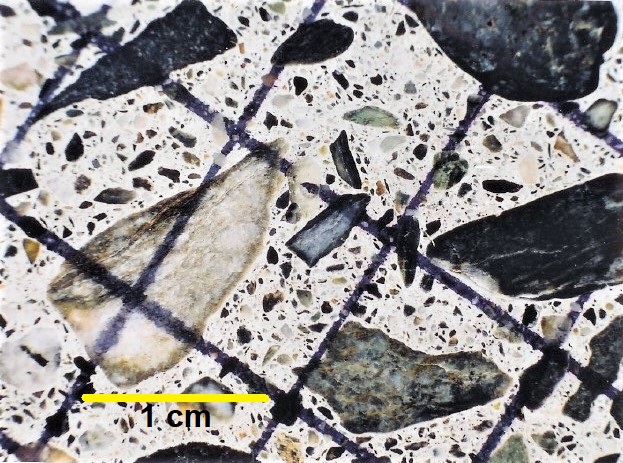
I have utilized this assessment technique on samples of concrete thought to be affected by Alkali-Silica Reaction (“ASR”) since the 1990s, when the DRI method was first presented at an ACI/CANMET workshop.
This method enables a suitably-experienced concrete petrographer to provide additional numeric data, supplemental to the Petrographic Examination per ASTM C856, to a Client. It provides a numeric index of the relative amount of evidence of ASR observed in concrete.
When used in the context of a program where a series of concrete samples are taken from a single site, the relative degrees of ASR can be compared in an intelligent and systematic manner, and can be used as an input in management of the concrete at the site.
This is very useful when the structure/s are of a critical or expensive-to-replace nature.